Plant City’s Hidden Aviation Giant Is Shaping the Next Generation of Flight.
The stillness of the cool Alaska morning vanishes in a puff of white smoke as an aircraft motor comes to life. Moments later, a bright blue Piper PA-18 Super Cub is taxiing along the rough, remote airstrip, its engine purring lazily. The pilot points her aircraft into the wind and advances the throttle. The bush plane quickly picks up speed, stands up on its main landing gear, and takes to the sky. The propeller pulling it up there is made by Sensenich Propeller Company, and they’ve been crafting them for almost one hundred years. Want to know something else? They make them right here in Plant City.
That’s right — located just down the road from Plant City Airport is their headquarters and advanced composite manufacturing facility. I have always had a special place in my heart for aviation, and my eyes look skyward, searching, each time I hear an aircraft passing overhead. When I learned that this industry leading company was located right here in town, I made a phone call. I wanted to find out more.
Amazingly, Managing Partner Steve Boser, invited me over for a chat, and tour of their operation. Sensenich (pronounced Sen-sen-ick) manufactures propellers from aluminum, carbon fiber composites, even wood. Each type requires its own vastly different manufacturing process and equipment, and Sensenich does it all right here.
Already a world leader in propellers for aircraft and airboats, they are expanding into new and exciting industries and applications. We’re talking about vehicles like autonomous drones and water taxis that can rapidly shuttle passengers while riding just a few feet above the water on a cushion of ground-effect air. Some of the protypes being worked on were so secret I was prohibited from taking photographs or writing about them.
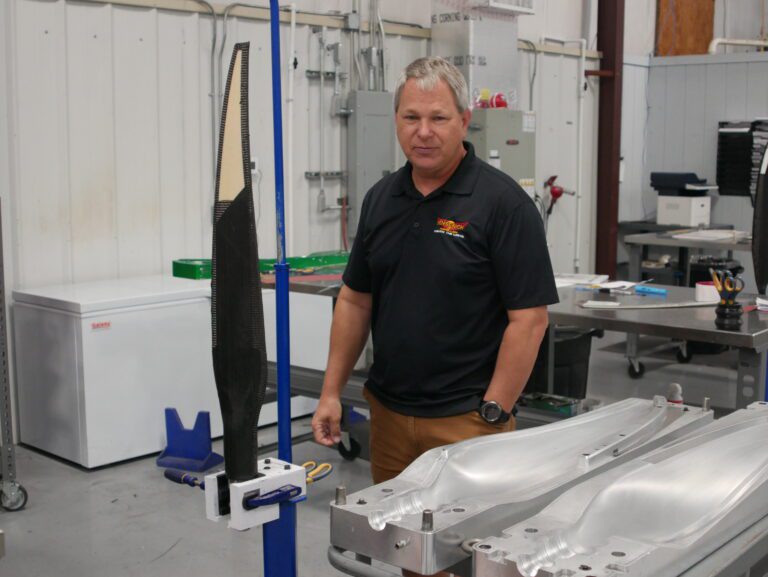
As we stood inside their new FAA Approved Composite Manufacturing Facility, Steve explained how Sensenich has pivoted to meet market demand for future applications.
“Carbon is the growth area. That’s where everything is going.”
Steve Boser is an Aeronautical Engineer and has been with Sensenich for 32 years. He points over to where carbon fiber airboat and aircraft propellers are being produced side-by-side.
“One of our biggest successes in the past couple of years has been FAA certified carbon fiber propellers.”

We walk over to the other side of the room where Brian is operating an Eastman laser machine. It’s cutting the pieces of carbon fiber used in each propeller, sometimes up to twelve per blade.
“We used to cut all these layers out by hand,” Steve tells me. The advanced laser cutting saves production time, improves accuracy, and minimizes material waste.
“We are constantly refining production and finding efficiencies.”
This special building is climate controlled; temperature and humidity are carefully regulated, and certain materials must be refrigerated. There are data loggers and controls to ensure everything meets the FAA’s strict manufacturing requirements.
Then we walked next door and strolled through their metal working shop. If the composite operation was the clean room, this was the opposite. A giant CNC cutting machine dominated the center. Inside of it, a two-bladed aluminum aircraft propeller was being shaped one slice at a time. Metal shavings were flying everywhere and a huge nest of spiral shaped silver “pencil shavings” was forming underneath. All around us, propellers were lined up neatly in rows, each awaiting the next step in their building process.
Their wood propeller operation in Lakeland is equally impressive, but for different reasons. The smell of freshly cut birchwood greeted me at the door. Surrounded by stacks of it, skilled operators control the various machines as these beautiful propellers are cut, laminated, and shaped into their final form. The process is intricate and hands-on — the craftsman here fashion these wooden propellers the same way they’ve been made since the birth of aviation.
The origin of the company is an interesting one. There were a couple of boys up on a dairy farm in Pennsylvania who grew tired of making the long trek through the snow to fetch the mail. They decided to build a motor-powered ice sled and began experimenting with custom built propellers. Not long after, in 1932, Sensenich Propeller Company was established, and it quickly grew to become the world’s largest manufacturer of wooden aircraft propellers. Over time they expanded into the airboat market, then added aluminum and composite propellers to their product line.
Then, in 1996, it came time for Sensenich to make a bold move. To remain competitive in the booming airboat industry they needed to be present at the center of it all — right here in Florida. They made the decision to move their entire operation down from Pennsylvania to Plant City. And 30 years later, business is booming. From a 10,000 square foot facility in 1996 they have expanded to over 30,000 square feet across multiple buildings in both Plant City and Lakeland, with close to 80 employees.
Having everything in one place also gives them a competitive advantage in the industry. “With the engineers and designers in one place, we gain manufacturing efficiency and decrease our time from model to production,” Steve explains.
Sensenich is always looking for local talent to be a part of their growing company as they chart a course into the future of aviation and beyond.
The next time you notice that familiar sound of an airplane in the skies above, or an airboat out exploring the lakes and rivers of Central Florida, know that it just might be a Sensenich propeller you’re hearing, representing the very best of what Plant City has to offer.