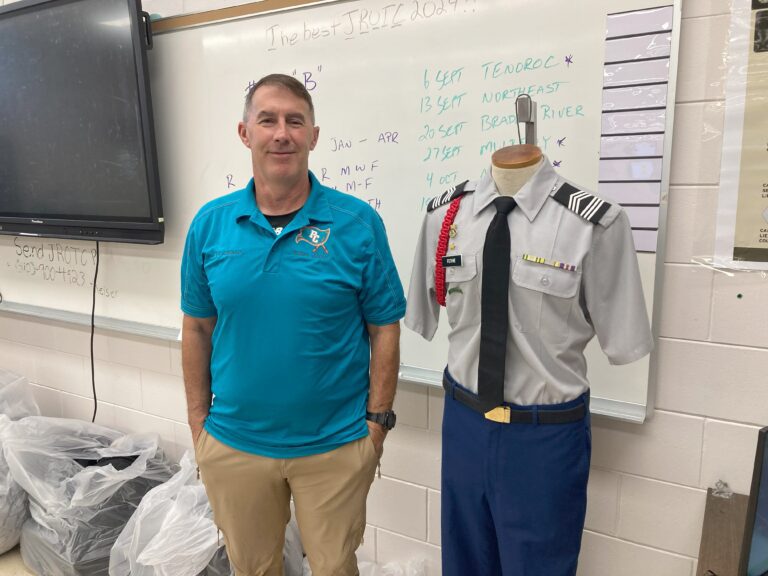
JROTC program teaches life skills.
“My mother still blames John Wayne,” Joseph Cieslo, Plant City High School Junior Reserve Officer Training Corps Senior Army Instructor, said. “If he was alive today, she would probably kill him. It was an old movie I saw back in the 70s with my dad watching TV—The Green Berets. And she says ever since then I was totally locked on to that.”
However, out of high school, Cieslo attended Georgetown University. “It was more for one semester there than my mother made in a year. It wasn’t feasible unless I had some way of paying for it. I traded my athleticism for a scholarship.” This scholarship in baseball helped him pay his way through school to earn a Bachelor’s Degree in Physics, and a minor in History. “It was probably my last year of college when I said, ‘You know what—this is not the path that I want. I always wanted to be an Army soldier.” So, Cieslo swore the Oath of Enlistment, and made a career in the Army. Ranger qualified and special forces qualified, he deployed with special forces. After 911, he deployed to Afghanistan where his team identified and developed targets, and trained the Afghan National Army. He served active duty for 21 years, earned a Bronze Star, and a Combat Infantryman’s Badge. He retired in 2013 as a lieutenant colonel.
“You spend 12 months in a combat zone, you are changed one way or another,” Cieslo commented. “Everyone comes out with their own experience—the way they process—what they see over there—the poverty, the death, the destruction.”
After retirement, Cieslo moved to Alaska with his wife, Candace (who was a captain in the Army), and four children. That is where he discovered Junior Reserve Officers’ Training Corps (JROTC). He first taught JROTC as a substitute. “Then a full-time position opened up,” he said. “They asked me if I wanted it, and I jumped on it.” The family lived for two years in Alaska, then had to return to Pennsylvania for family reasons. Cieslo taught JROTC in that state for one year at a high school.
After Afghanistan fell apart in August of 2021, Joseph and Candace decided they both needed to do something. So, they linked up with a group of special operators from their past. In non-Department of Defense operations, they helped evacuate more than 12,000 people from Afghanistan. “We were just a small cog in a big machine, but we did our part….There were a lot of kids who were orphaned or unaccompanied in the UAE. There were three kids who could not find a pathway to the U.S.” One of them survived the explosion at Abbey Gate that killed 13 U.S. service members and 169 Afghan civilians. “We were afraid they were going to send them back, which would have been very bad for them.” So the Cieslos took them in as asylum seekers. Their children easily embraced the Afghan boys, and refer to them as their brothers.
At PCHS, there are five JROTC class periods that educate about 100 students. The other instructor is Aarik Karlson, who retired as a first sergeant. On a normal day, Cieslo and Karlson arrive at PCHS at 7:00 a.m. and are there until 6:00 p.m. On Mondays, students wear a cadet uniform. Tuesdays and Wednesdays are academic days where the students learn things like U.S. History, Military History, and the Constitution. In the classes, students and the instructors discuss current national issues in a mature way. Thursdays, the students take part in team lab—things like drill, the physical fitness team, rifle marksmanship, and flying drones. The JROTC instructors work to set the students on a path to good health and fitness, and to the long-term betterment of themselves.
“This is not a military program, it is a citizenship program,” Cieslo commented. Less than 15 percent of people who join JROTC go into the military. “We don’t want people to think we are trying to create Army soldiers here—which we are not. We are trying to create good citizens who have the military discipline of showing up daily, showing up on time, showing up on time prepared, and doing the right things—all those organizational skills that they say we have—we hope to pass that down to the kids. In the end, I see the change that can be brought into their lives and the positive effect it can have on them.”