While studies show expansion may be inevitable, longtime rural residents warn it could easily erase the character of their communities.
Bonnie and Fred Cropper thought they had already escaped urban sprawl once.
The couple fled the Lithia/Bloomingdale area after flooding from nearby development damaged their property, eventually settling a lawsuit in 2006. They relocated to rural land along Gallagher Road, seeking the quiet agricultural lifestyle they had always wanted.
Now, they fear history is repeating itself.
“They’ve already run us out once,” Fred Cropper said Thursday at a public meeting on potential development along the Interstate 4 corridor. “If you build it, they will come.”
“It will just ruin the area,” his wife added. “Can you imagine what this would do to this area? It would change it completely.”
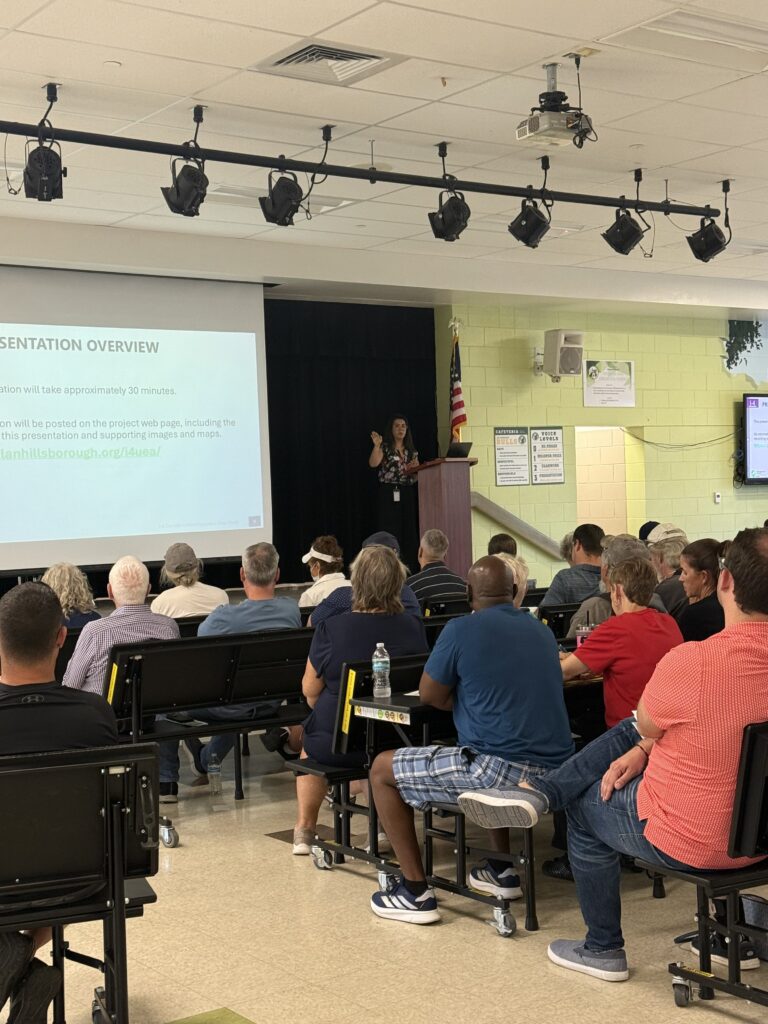
The Croppers were among more than 70 residents who attended the April 16 Plan Hillsborough’s public input session on the I-4 Corridor Urban Expansion Area Planning Study, a planning effort examining whether to extend the county’s Urban Service Area into currently rural land east of Tampa. The boundary determines where the county provides water, sewer, roads, and emergency services to support existing and future development.
Their frustration reflects a tension playing out in rural areas where some residents are averse to urban sprawl.
Hillsborough County’s population is estimated at roughly 1.63 million in 2026, reflecting a 1.5% annual growth rate, and has grown more than 32% since 2010.
County planners expect the population to increase by approximately 350,000 more people and 107,000 more jobs by 2045, growth that officials say is rapidly consuming available land inside the existing urban boundary.
Vacant and developable land within the current Urban Service Area has become increasingly constrained, planners say, making expansion of that boundary a practical necessity if the county is to accommodate the growth already underway. New developments are consuming hundreds of acres of land a year.
Officials were quick to stress that the study is not a rezoning action.
“We’re just studying it to see what is realistic,” one planner told the crowd. “Your input will help guide Hillsborough County commissioners, who will ultimately vote on this.”
The economic stakes are significant. Planners project the I-4 study area alone could absorb roughly 42,500 new residents and more than 11,800 additional jobs by 2050, with potential demand for up to 6.6 million additional square feet of industrial space and up to 1.9 million square feet of new retail. The corridor’s fastest-growing employment sectors are transportation and warehousing. The massive distribution facilities have reshaped the landscape along County Line Road and the broader I-4 and I-75 corridors in recent years.
That industrial boom has come with tradeoffs. Rents in the study area have climbed 15% since 2020, and the median home value now stands at $447,800. Countywide, roughly 18.5% of the population was living with severe housing problems as of 2025.
Transportation infrastructure is already straining under the growth. Planners acknowledge that beyond I-4, I-75, U.S. 92, and State Roads 574 and 60, most of the study area is served only by local two-lane roads with no transit service and limited sidewalks or bike lanes. Road widening projects for key corridors are planned but remain at various stages of the approval process.
A county sustainable growth study previously found that some longtime residents feel growth and development have largely wiped away the reasons they moved there originally.
“We don’t care if we have to drive to the grocery store,” Bonnie Cropper said. “We like living in a rural community. We moved out here because we wanted this.”
Planners said rural preservation is part of the study’s framework, pointing to environmental sensitivity mapping that has already identified lands to be excluded from development and a stated goal of directing density toward existing corridors rather than scattering it across the landscape.
“It’s not coming into areas where it doesn’t make sense,” one planner said. “We’re protecting our natural and rural lands and putting growth and density where it makes the most sense.”
Hillsborough County voters renewed a half-cent infrastructure sales tax in November 2024, extending it through 2041, providing a funding stream for roads, utilities, fire stations, and schools that any expansion would require.
The four-phase study is expected to conclude in fall 2026 with a final plan and maps. Residents can participate in the Stage 1 community survey at planhillsborough.org/i4-lms-study.
For the Croppers, the process offers little comfort. Lithia Pinecrest Road, they noted, is still a two-lane road, a reminder that even where growth has already arrived, infrastructure often lags far behind.