Competition from farms in Mexico, weather, labor costs — they’re all stacked against Plant City’s proudest tradition.
By Thad Moore | Tampa Bay Times
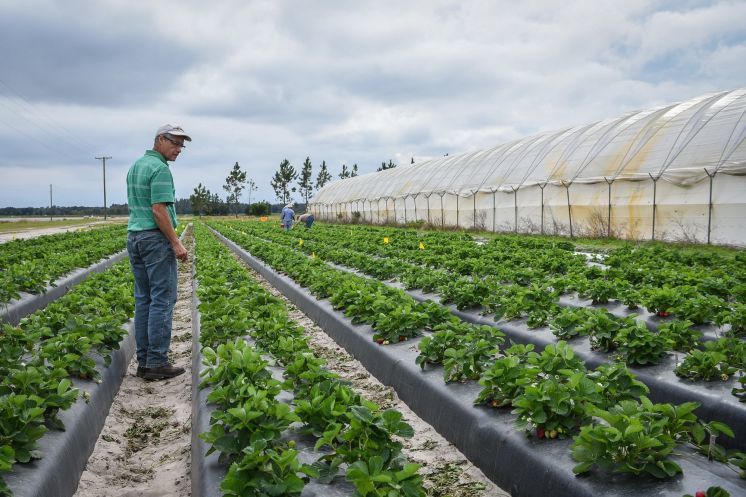
Vance Whitaker and his colleagues are growing about 10,000 strawberry plants this year, but they'll plunk small yellow flags beside only a few hundred in the rows of the University of Florida's research farm.
They are the prospects, the select group that will be planted again next year because they showed good traits — a good yield, say, or especially sweet berries.
If Whitaker is lucky, one of them might be the plant that rescues Florida's strawberry industry.
The Growing Seed
Whitaker and his team are looking for a special kind of strawberry: one that can be planted earlier in the year, stand up to the heat of late summer and still produce tasty fruit.
If farmers could pick berries even a week or two earlier, the researchers figure, it might be enough to keep them afloat. It would give growers something they used to enjoy: a corner on the market while strawberries are sparse and prices are high.
For decades, when winter rolled around, Florida strawberries reigned supreme. Starting in December, for a few months a year, most of the strawberries Americans ate were grown in rural Hillsborough County, until California’s much larger crop ramped up in the spring.
Plant City declared itself the "Winter Strawberry Capital of the World."
But that was before Mexico surged onto the market. Strawberries grow well there this time of year, and farmers there have quickly chipped away at Florida's wintertime advantage.
The Mexican berry business is young, but growing fast. The industry didn't start a trade group until 2009, but it already counts some of the biggest names in the business as members. Berry farms in Mexico employ about 100,000 people and bring in $1 billion a year, McClatchy reported in March.
Americans bought more than 355 million pounds of strawberries from Mexico last year, an increase of 46% since 2011, according to the U.S. Department of Agriculture. Mexican production accounted for virtually all of the United States' strawberry imports. Reach back to 1990, and Americans imported only 32 million pounds of the fruit, according to the USDA.
”It's ruined us," said Mark McDonald, president of Sweet Life Farms in Plant City. Small farms have been hit especially hard, he said. "They're trying, trying, trying, but it's a losing battle."
Every year, Matt Parke, who runs Parkesdale Farms in Dover, hears about four or five more growers who have given up the trade. Fertilizer and diesel have gotten more and more expensive over the years, and strawberry prices haven't risen, thanks to the influx of imported berries.
Farmers are lucky to turn a profit every three years, Parke said. For some, that's been enough to cover the costs of a couple of tough years, but others have run out of choices.
"They went belly up. There wasn't any other option," Parke said. "The market is what the market is.”
Mexico's strawberry explosion stems from a handful of factors. For one, local farmers point out, growers there have a big edge on labor costs, and producing strawberries is labor-intensive: workers walk each row every three days, plucking berries by hand.
Hiring farmhands to pick fruit accounts for 40% of the cost of growing strawberries, said Zhengfei Guan, a UF agricultural economist. Growing in the U.S. costs three times what it costs in Mexico, he said.
That difference is partly balanced by the higher cost of shipping strawberries to the United States and the infrastructure-heavy farming method preferred in Mexico, said Soren Bjorn, executive vice president of Driscoll's of the Americas, one of the largest strawberry producers in the United States.
But in the early 1990s, legal changes in Mexico made large-scale farming more viable, and NAFTA dropped trade barriers. American producers found that berries grew well there, and its wintertime climate was more stable than Florida's.
And then there's the factor that Bjorn says played a bigger role than any other: Americans want strawberries year-round, and Florida's industry couldn't fill supermarket shelves alone. That's why major U.S. producers like Driscoll's set up shop in Mexico, he said.
"We could sell a lot more Florida strawberries if we had them," Bjorn said.
Watering the Roots

Still, Whitaker and Guan think Florida growers could carve out a new niche in the strawberry market. The fruit doesn't keep long, and because they can't be stored for long periods, prices are prone to big swings. On one hand, that means prices fall quickly once production is fully under way, but on the other, it means prices are high in November, when few berries are ready to pick.
In a study published last month, Whitaker, Guan and Feng Wu, another UF economist, found Florida growers could use those plump margins to their advantage.
If farmers could get to market just a week or two earlier, they think growers could squeeze $3,000 more in sales out of each acre. By comparison, growers usually need to make $28,000 to $30,000 an acre just to break even, said Andy McDonald of Sweet Life Farms, a past president of the Florida Strawberry Growers Association.
"Three thousand (dollars) an acre could be the difference between making money and losing money very easily," said Gary Wishnatzki, owner of Wish Farms in Plant City.
Developing a strawberry to make that happen is no easy task. Breeders have gradually taken the wild strawberry, a plant that isn't native to Florida and naturally produces fruit the size of a penny, and adapted it to grow plump berries in the warm Florida winter. Growing earlier in the year means pushing the plant even further.
It's a slow and painstaking process of crossing plants' DNA, growing thousands of plants and seeing what works. It takes six or seven years of testing before a promising seedling — one of the plants marked with yellow flags — will be grown commercially, Whitaker said. Only one plant in every 20,000 to 30,000 will make it that far.
But if they can pull it off, Whitaker and his colleagues think Florida farmers could get a brief but important upper hand against their newfound competition. It might not make strawberry growing a lucrative business, but it could at least help them break even.
"That's what we're trying to do here," Whitaker said, "is try to keep these guys sustainable."
Contact Thad Moore at tmoore@tampabay.com.